Technology Business Management
HERM tells you what you run and what it does. TBM adds what it costs and what it delivers for that cost — turning the estate model into a conversation about value, in language the CFO and the board already use.
What TBM is
Technology Business Management is a standard discipline and taxonomy for describing the cost, consumption, and value of technology. Stewarded by the TBM Council, it maps spending through three connected layers: the finance view (what appears in the ledger), the IT / technology view (the towers that money buys — compute, storage, network, applications, support), and the business view (the services and capabilities the institution actually consumes).
Its purpose is to answer a question HERM alone can't: not just "what do we run," but "what does it cost to run, who consumes it, and is it worth it." TBM is how technology spend gets explained in business terms.
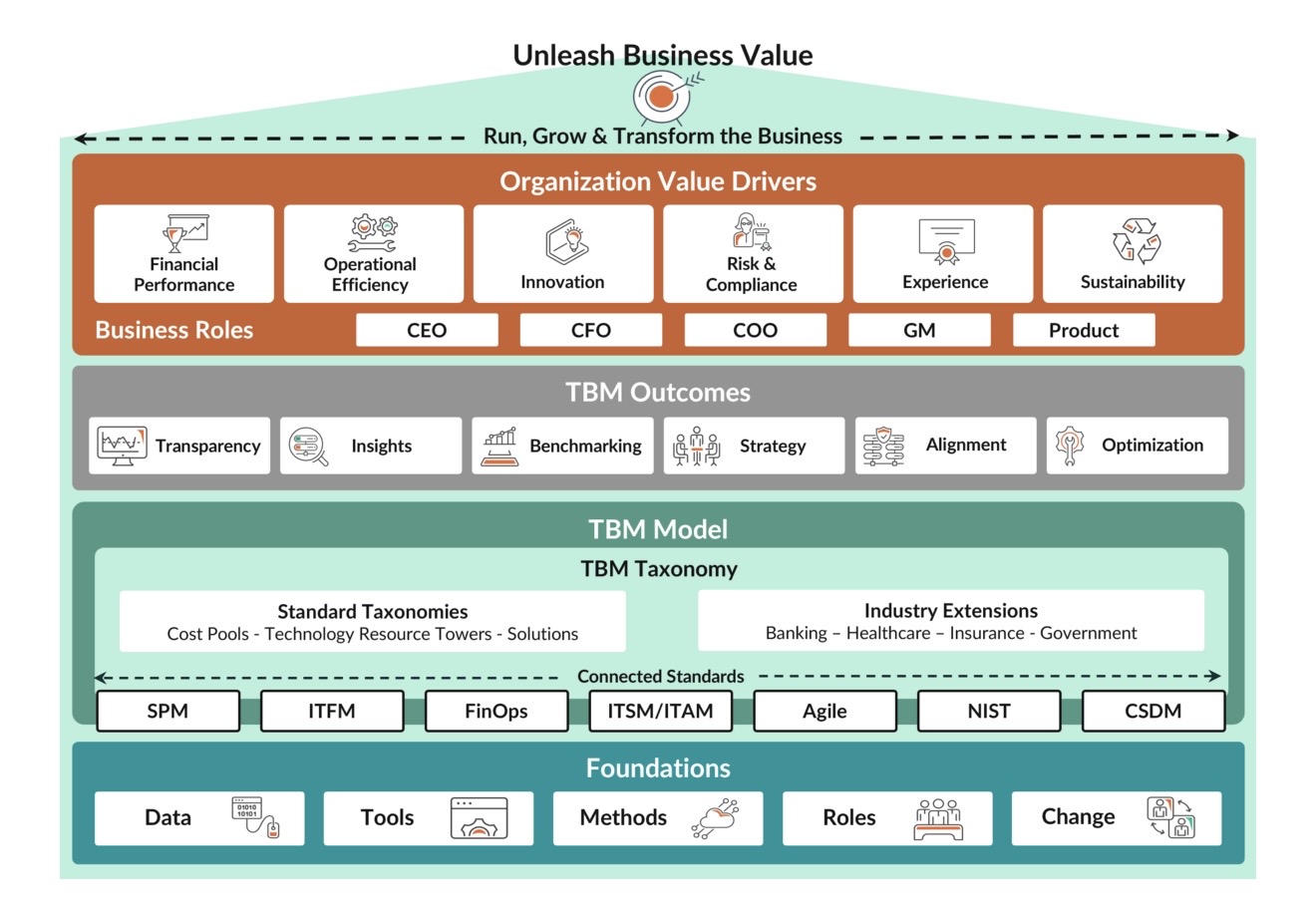
The TBM framework
The framework stacks from a value goal at the top down to the foundations that sustain it — each layer serving the one above. From the TBM Council framework.
Why pair it with HERM
HERM and TBM are complementary standards that share the same spine: the capability. HERM names the capabilities and the systems that deliver them; TBM attaches cost and consumption to those same capabilities. Join them on the capability and every question in the "Putting it to work" section gains a dollar figure.
Not just "we run Student Enrolment," but what it costs to run — across every system that delivers it.
The overlap the capability lens surfaces now carries a price tag — the actual saving from consolidating.
What it costs to support a student, a researcher, or a faculty journey end to end.
Components to add
Extending the model toward TBM means adding a cost-and-value layer to each record and a few new views. A pragmatic starting set:
Beyond licence: implementation, hosting, integration, and the staff effort to run each system.
Group spend into TBM towers (compute, storage, network, applications, delivery, security) so IT cost is comparable across systems.
Who uses each system and how much, so cost can be attributed to the units, capabilities, and journeys that drive it.
Cost per student, per account, per transaction — the figures that make efficiency legible to leadership.
A quadrant per system: Tolerate, Invest, Migrate, Eliminate — pairing cost with fitness to guide the roadmap.
Cost tracked over time and against peers, so a number becomes a direction, not just a snapshot.
Start small: attach total cost of ownership and a TIME rating to each system you've already recorded, then roll those up by capability. Even that much turns "these three systems overlap" into "these three systems overlap and cost $X a year," which is the sentence that actually moves a budget.
TBM is a discipline of the TBM Council. This page describes how it complements HERM; the cost figures and TIME ratings are local extensions an institution would populate with its own data.